
Dalton City Directory Collections
Dalton has an unusually useful online window for mid-century family research. The Dalton-Whitfield County Library worked with Georgia Public Library Service and the Digital Library of Georgia to digitize directory volumes. The 2021 announcement describes 11 full-text-searchable Dalton and Griffin volumes spanning 1940 through 1963 as a combined group. It verifies Dalton volumes from 1940 and 1963, but it does not establish a complete annual Dalton run. Check the collection browse before claiming that a specific year exists.
| Collection | Years | Where Held | Access |
|---|---|---|---|
| Dalton city directories | Digitized selections, 1940-1963 | Dalton library / DLG | Free full text and scans |
| Polk's Dalton directory | 1963 verified | Digital Library of Georgia | Free online |
| Sanborn fire maps | 1885, through 1914, and 1941 points verified | LOC / UGA / DLG | Free LOC images; some UGA access through GALILEO |
| North Georgia Citizen | 1868-1924 verified | DLG Historic Newspapers | Free OCR and page images |
| Federal census | Public schedules through 1950 | NARA / library databases | Free and library-assisted routes |
| Whitfield county microfilm | Surviving series, often pre-1900 | Georgia Archives | Online catalog cards; records at Archives |
This coverage table separates a known span from a continuous run. The verified holdings should be paired with library staff help, because shelf items and licensed databases may not be fully described online. Missing years can be bridged with newspapers, census records, maps, deeds, and cemetery evidence.
Dalton Directories Online, 1940-1963
The official directory digitization announcement links readers into the Dalton and Griffin project. Search the OCR for a surname, a street, or a business, then open the scan around each hit. The directory page itself, not the machine text, is the evidence.
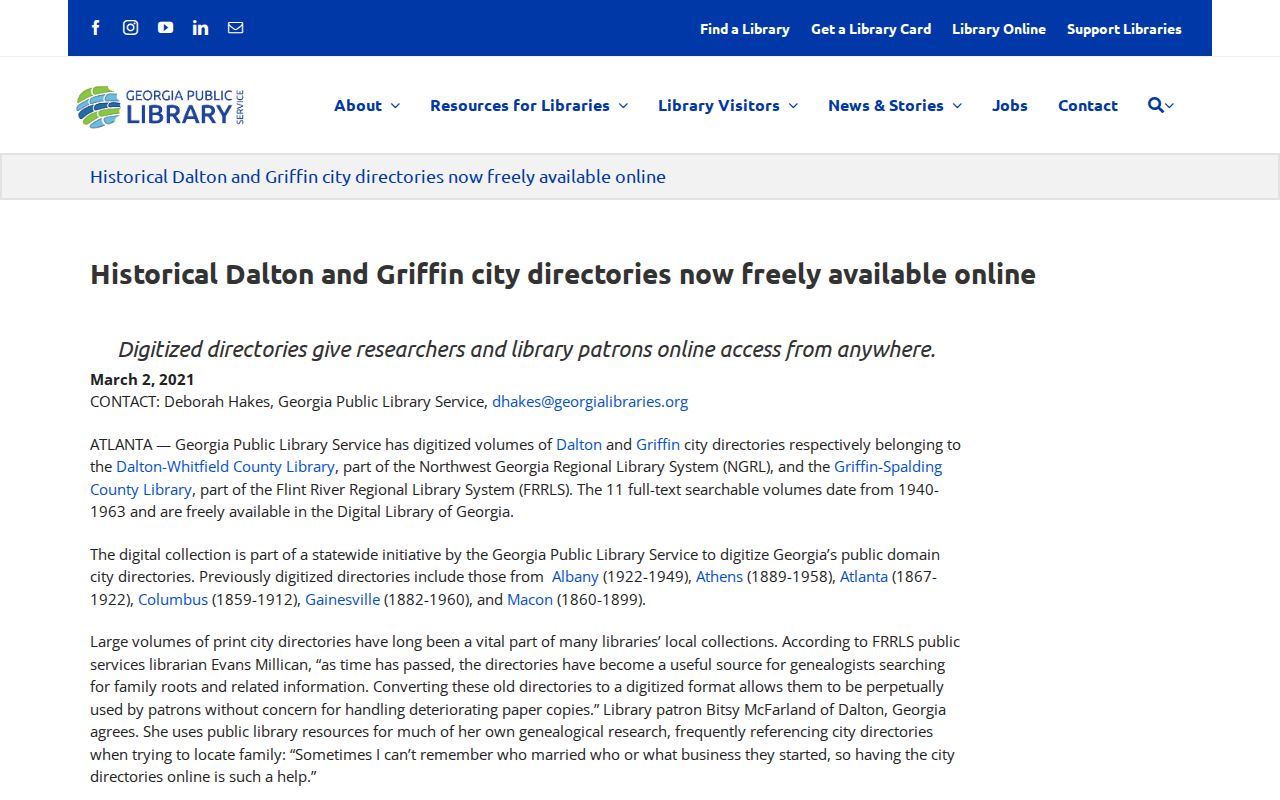
The image shows the collection's public entry point. Because the announcement describes a combined 11-volume set, use the item list to verify each Dalton title and year before adding it to a family timeline.
Search name variants and initials. Narrow columns, worn type, ditto marks, and ads can confuse optical character recognition. Street-order context often exposes a bad OCR spelling that an alphabetical search misses.
Dalton City Directory Library Desk
The Dalton-Whitfield County Library local-history service is the best fallback when a volume is absent online. The library is at 310 Cappes Street in Dalton, and its phone is 706-876-1360. Ask staff to identify city or reverse directories, telephone books, newspapers, obituary material, yearbooks, and county originals.
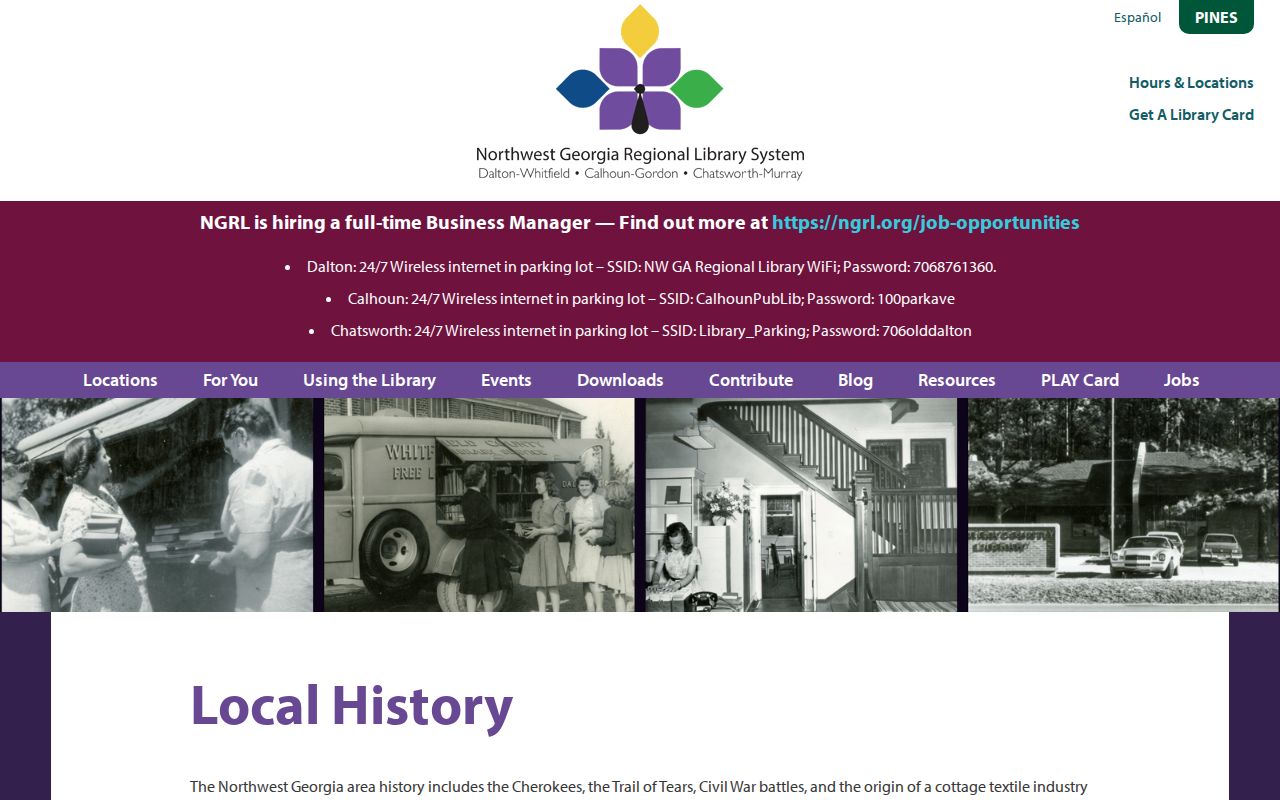
The library page also lists Ancestry Library Edition for in-library use, HeritageQuest through GALILEO, DLG, DPLA, federal genealogy guidance, and USGenWeb. Those routes help test a directory find without treating one printed line as a full identity.
Call ahead about current hours, shelf holdings, and access terms. Bring each spelling, date, street, and associated person already known. A precise request gives staff a much better chance of locating an unlisted volume or newspaper issue.
Read a Dalton Directory Entry
A 1963 Dalton entry can present a surname, given name or initial, occupation abbreviation, and address. Many entries include a spouse in parentheses, an employer, or a status such as widow or retired. Record the whole line, page number, title, and year. Nearby entries may contain relatives or reveal that the OCR split one household into separate results.
| Name | Surname, given name, and often an initial |
|---|---|
| Spouse | Name commonly placed in parentheses |
| Work | Occupation or employer, often shortened |
| Address | House number and street with residence or home marks |
| Status | Marks such as widow or retired where printed |
- Criss-cross directory
- A section arranged by street and number, useful for reading a block in order.
- Householder index
- A name or address list focused on people responsible for a household entry.
- Abbreviation key
- The volume's guide to short forms such as h, r, emp, wid, and ret.
The letters are publisher conventions, not universal rules. Consult the key in that exact volume. The 1963 alphabetical name list begins on page 347, and its title includes Brookwood, City View, and Pine Hills. That wording is a reminder that directory geography can change from one edition to another.
Inside Dalton's 1963 Polk Directory
The 1963 Polk directory record offers searchable text and the original page images. Its title's named communities help define the edition's reach. Do not assume an earlier volume covers the same area.
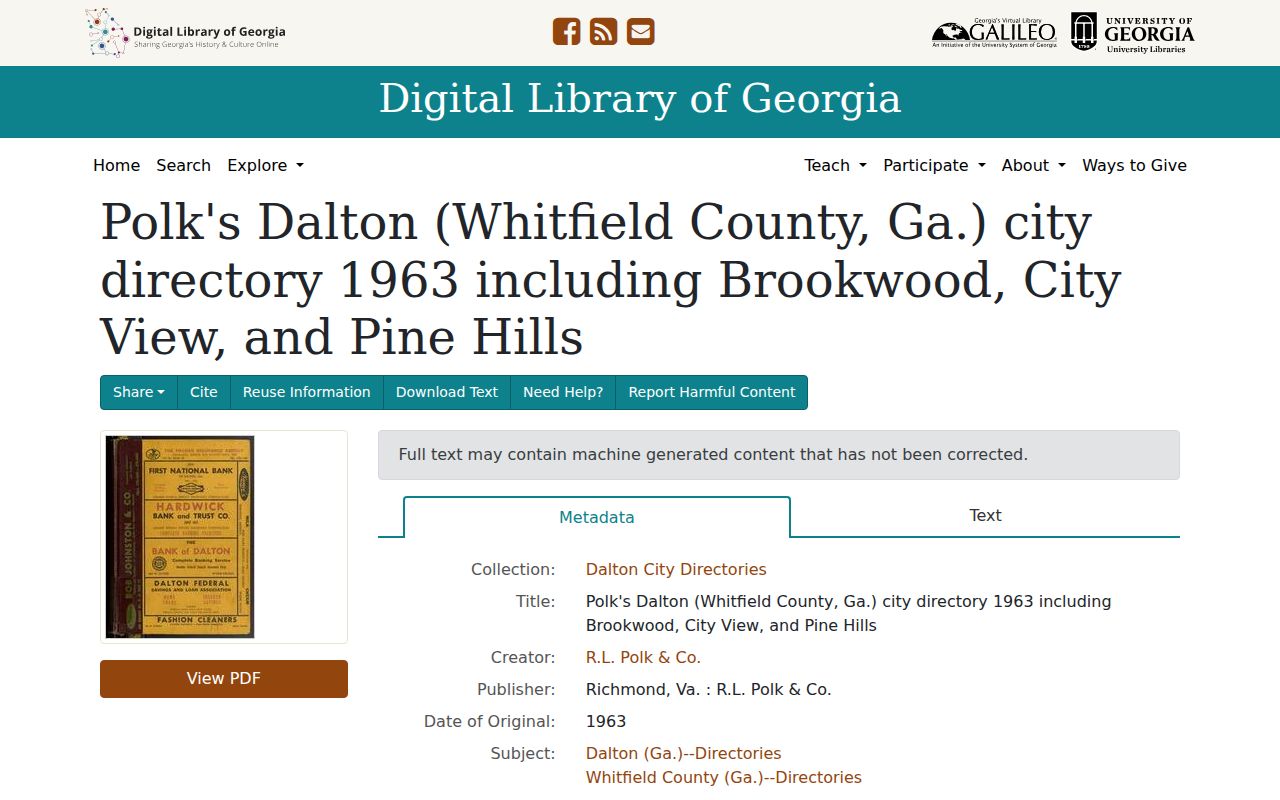
The record screen is a starting point for browsing, citation, and download. After a text hit, inspect the page image, the entries above and below it, and the abbreviation page.
Search a spouse or another adult in the household when the expected head does not appear. A first appearance can narrow an arrival; a disappearance can suggest a move, death, omission, or changed listing. It does not prove which event occurred.
Dalton's Bedspread Boulevard Clue
The 1940 directory includes a map titled “Dalton and Bedspread Boulevard along the Dixie Highway” on page 20. It is a vivid local marker from the textile era and a practical street reference. Compare it with the 1941 Sanborn set, whose one-year proximity creates a tight check on building and address context.
A 1949 “Champion Home Town” scrapbook adds photographs, clippings, club rosters, and textile-industry material. The scrapbook literally carries “Bedspread Center of the World” in chenille. It reflects a promotional civic campaign, so its rosters are selective rather than a citywide directory.
Use the map and scrapbook to explain an entry's setting, not to infer an unlisted resident. A named organization or workplace becomes a lead for a newspaper search, while the printed volume remains the dated name-and-address source.
Maps Behind Dalton City Directories
Sanborn maps show street orientation, building footprints, construction or use symbols, and house-number context. Verified Dalton holdings include January 1885, UGA listings through 1914, and a 1941 Library of Congress set with 23 sheets. The 23-sheet count is useful when tracking whether a search reached the full set.
The Library of Congress Dalton Sanborn record provides the public-domain 1941 sheet navigation. The North Georgia Citizen run from 1868 through 1924 adds notices, ads, and community reports in DLG's historic newspaper collection. Pair names cautiously, since newspapers and maps can describe context without proving residence.
The volume supplies the printed name. A map supplies the block and structure. A census supplies household composition at a nearby snapshot. Record conflicts rather than forcing all three sources into agreement.
Rebuild Dalton Directory Gaps
Sherman's forces burned Dalton's first courthouse in 1864. Georgia Archives also marks Whitfield County with an 1883 courthouse disaster. A disaster marker does not mean every series was destroyed. Check the county cards record by record before declaring a gap.
The Georgia Archives county microfilm catalog lets researchers select a county and identify surviving series, often for pre-1900 material.
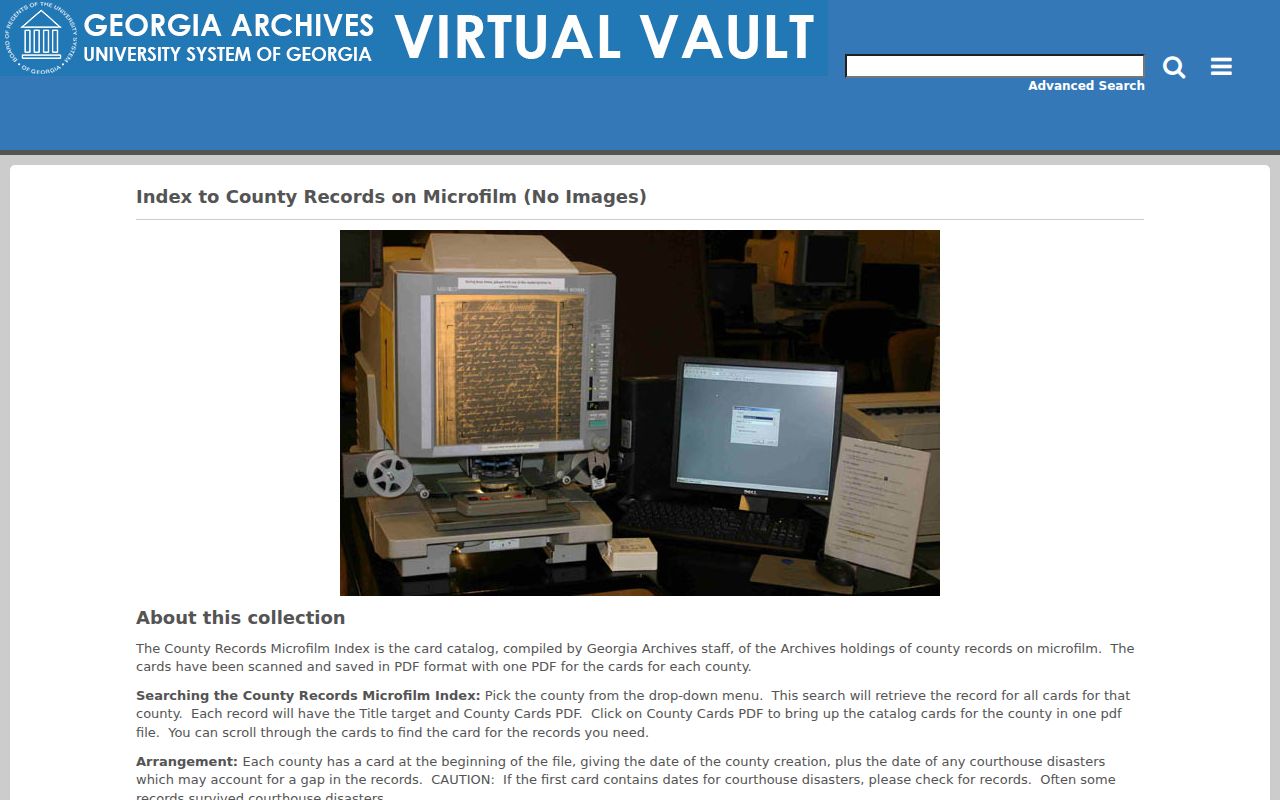
The cards are a catalog, not record images. Once a series is identified, ask the Archives or courthouse how to inspect it. Census, tax digests, church records, cemetery evidence, newspapers, Sanborn sheets, and deeds can bridge missing years.
Dalton Records Across the Years
A short timeline places printed volumes beside other records that survived. It also prevents a common error: assuming that the first item found online marks the start of local record keeping.
| 1864 | Sherman's forces burned the first Whitfield courthouse, making outside sources vital for reconstruction. |
|---|---|
| 1883 | Georgia Archives marks another courthouse disaster; surviving series still need a card-by-card check. |
| 1884 | Dalton City Clerk municipal minutes and official documents begin. |
| 1885 | The earliest verified local Sanborn point supplies block and building context. |
| 1940 | A verified digitized volume includes the Bedspread Boulevard map and pairs with the federal census. |
| 1941 | The verified Sanborn set contains 23 sheets for a close map comparison. |
| 1963 | The verified Polk volume includes Brookwood, City View, and Pine Hills. |
| 2021 | The official digitization announcement described the searchable Dalton and Griffin project. |
These are verified reference points, not proof of full annual coverage. Between them, use newspapers, census schedules, deeds, maps, cemetery evidence, and staff-identified library material. A sound timeline shows both what exists and what remains unverified.
Trace Families in Dalton Directories
Build a family timeline one publication at a time. City directories provide useful points between federal census years, especially around the public 1940 and 1950 schedules. They can narrow a move or death, but each change needs a second source.
- Begin with a known name and year. Copy the entry exactly, including initials, spouse, marks, address, and page.
- Move to the next available Dalton city directory. Note a first appearance, last appearance, address shift, and work change.
- Search the spouse and other adult household members when the first name vanishes. Check street-order material where the volume includes it.
- Pair the 1940 directory with the 1940 census, and place nearby directory editions around the 1950 census.
- Use newspapers, obituaries, probate, cemetery records, or deeds to explain the break. Do not assume a disappearance means death.
Owners and occupants must remain separate. A deed identifies title parties. A city directory prints an occupant or subscriber according to its own methods. The modern address-record chain is covered in the Dalton street directory when a family trail reaches a current parcel.
Note: Cite the directory title, year, page, and image, since OCR text can change when a collection is reprocessed.